
Consulting Assessment
AI & Automation Readiness Assessment
Before investing in AI tools, custom software, or another disconnected system, understand where your workflows are actually ready — and where simpler automation, better data structure, or process cleanup should come first.
Engineered Workflows helps teams identify practical opportunities for AI and automation, prioritize the highest-value use cases, and create a roadmap that can turn ideas into reliable working systems.
 Assessment
Best fit for teams asking:
- Where could AI actually help our business?
- Which manual workflows are worth automating first?
- Is our data ready for AI, dashboards, or custom tools?
- What should we build, buy, improve, or avoid?
Practical, Not Hype-Driven
AI is only useful when the workflow is ready for it.
Many teams are being pushed to “use AI” without a clear understanding of where it fits. The real opportunity is usually not a chatbot by itself. It is a better workflow: cleaner inputs, fewer manual steps, more reliable reporting, stronger follow-up, and better use of the data and documents the business already has.
This assessment is designed to separate useful opportunities from distractions. Some ideas may be ready for AI assistance now. Others may need spreadsheet cleanup, reporting automation, file organization, database structure, or process documentation before AI can create meaningful value.
What We Review
A structured look at your workflows, data, tools, and opportunities
Workflow Inventory
We identify recurring processes that consume time, create bottlenecks, or depend too heavily on email, spreadsheets, manual updates, or one-person knowledge.
Data & Document Readiness
We look at where information lives, how reliable it is, how it moves through the business, and whether it is structured enough to support automation or AI-assisted workflows.
AI & Automation Use Cases
We identify practical use cases such as summarization, classification, email triage, document review, reporting support, data cleanup, workflow routing, and decision support.
Risk, Effort, and ROI
We score opportunities based on business value, frequency, complexity, data availability, risk reduction, and how clearly the improvement can be implemented.
What You Receive
A clear view of what is worth doing
The goal is not to produce a buzzword-heavy strategy deck. The goal is to give your team a clear view of what is worth doing, what should wait, and what the first practical steps should be.
- Workflow and data readiness summary
- AI and automation opportunity map
- Use-case prioritization by value, complexity, and readiness
- Risks, blockers, and cleanup areas to address first
- Recommended 30/60/90-day roadmap
- Optional implementation path for quick wins, automation sprints, or ongoing support
Example Output
Assessment deliverable preview
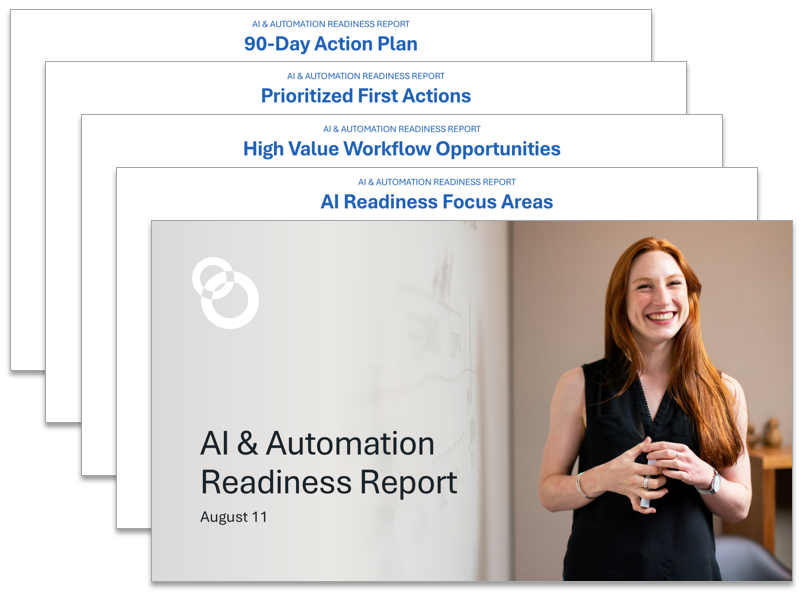
Example deliverable preview. Actual recommendations are based on your workflows, your tools, your data, and your business priorities.
Assessment Process
Designed to move quickly from uncertainty to clarity
Discovery
We discuss your goals, current pain points, existing tools, team workflows, and where AI or automation is already being considered.
Workflow Review
We review representative workflows, reports, spreadsheets, data sources, documents, handoffs, and manual steps that drive recurring work.
Roadmap
You receive a prioritized roadmap showing what to improve first, where AI fits, and which implementation options are most likely to create value.
Why Engineered Workflows
Engineering problem-solving for real business workflows
Engineered Workflows is built around a practical idea: the best systems are the ones that fit how people actually work while reducing the manual effort, friction, and error risk around them.
The work often starts in familiar places — Excel, Outlook, shared drives, exports, reports, manual checklists, and disconnected systems. From there, the right solution might be Power Query, VBA, Python, a dashboard, a lightweight database, a custom web app, or an AI-assisted process.
The assessment gives your team a structured way to choose the right starting point before spending time or money on the wrong solution.
Relevant capabilities
The goal is not to force every problem into AI. The goal is to identify the simplest, most reliable path to better work.
Good Fit
This assessment is a strong fit if your team is asking what to improve next
You may be ready if...
- Leadership wants to explore AI, but the right use cases are unclear.
- Important processes depend on spreadsheets, email, exports, or manual follow-up.
- Reports or recurring workflows take longer than they should.
- The team knows there are better ways to work but needs help prioritizing.
The outcome
You leave with a clear understanding of where AI makes sense, where automation should come first, what data or process gaps need attention, and which opportunities are most likely to produce real business value.
From there, the next step may be a quick win, an automation sprint, a deeper workflow build, or ongoing support.
See related workflow and automation work
Review examples across reporting, process improvement, automation, and custom tools.
Client Feedback
“It has been really successful all day - saved me about a weeks work so far.”
“Your proactive approach and thorough attention to detail have played a significant role in advancing the IWMS Project. By regularly identifying and sharing possible risks, you help improve project results and foster an environment of openness and continual progress”
“You are the best.”
“Mark, you are amazing! I knew you could make this happen! Thank you for jumping so quick on getting this done.”
“You are at the magical intersection of people, process and technology optimization by leveraging and acting on data and automation.”
“This is awesome work Mark, I love it! Amazing work!”
“You have a talent for optimization/automation of systems and processes that is very useful and valued for our company if we are ever going to simplify the way we work. Great job!”
“Thanks Mark! This is a great example of fresh eyes clearly seeing the problems to fix.”
“Thank you so much for all the work you did and it seemed like it was more than usual. Everything you do is so helpful to me and always timely and correct.”
“Mark - that is sheer unalloyed genius. A much more elegant solution.”
Ready to Start?
Let’s identify where AI and automation actually fit
If your team is interested in AI but unsure where to begin, this assessment creates a practical starting point and a roadmap for what to do next.